Op-Ed: Y’all Street Runs on Data Centers
Regional News

Audio By Carbonatix
9:09 AM on Tuesday, September 29
Texas is becoming a financial powerhouse.
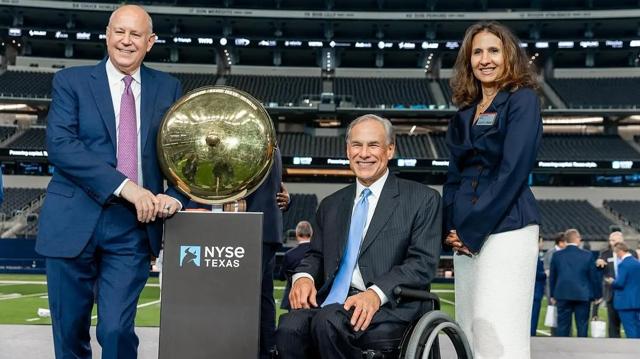
For generations, New York has been synonymous with American finance. Today, Texas is building something of its own. Dallas is attracting banks, investment firms, financial talent, and major stock exchange operations. The Texas Stock Exchange launched trading this summer. Nasdaq Texas and NYSE Texas have expanded their own operations in the state.
It is easy to see why Texans are excited about Y’all Street. But there is an important part of this success story that receives far less attention. Modern finance runs on technology, and that technology depends on data centers.
The image most Americans have of a stock exchange is still a trading floor filled with people buying and selling shares. That is no longer where most trading actually happens. Modern exchanges are sophisticated technology platforms.
When an investor places a stock order, computers transmit it across high-speed networks to an exchange. Matching engines process those orders, connect buyers and sellers, report trades, and distribute information back across the financial system. All of this can happen in fractions of a second.
Nasdaq Texas, the most tech-forward of the exchanges, operates on Nasdaq's global technology infrastructure. The Texas Stock Exchange has built its own electronic matching engine. Behind these exchanges are server networks and computing infrastructure that make modern markets possible, and that technology is about to become even more important. American markets are moving toward nearly around-the-clock trading. Nasdaq and NYSE are preparing for trading 23 hours a day, five days a week. Instead of shutting down for most of the night, markets will increasingly remain open while much of America sleeps.
There are good reasons for the change. American markets attract investors from around the world. An investor in Asia or Europe should not necessarily have to organize their day around New York business hours to invest in an American company. But longer trading hours also mean the technological infrastructure supporting financial markets must operate longer and remain available.
The transition toward 23-hour trading is another reminder of how dramatically finance has changed. Markets that once revolved around a physical trading floor increasingly depend on digital infrastructure that operates almost continuously. The exchanges are one of the most visible parts of what is happening in Texas, but it's much more than that.
Dallas has quietly built one of the country's largest financial workforces. Financial activities now account for roughly one in 10 jobs in the Dallas area. Goldman Sachs is building an 800,000-square-foot campus that is expected to house 5,000 employees. JPMorgan Chase, Charles Schwab, Fidelity, and Wells Fargo have established enormous operations across North Texas.
These companies employ bankers, analysts, traders, advisers, and thousands of other professionals. They also depend on an enormous amount of technology. Every time someone checks a bank balance on a phone, transfers money to a family member, swipes a credit card, applies for a mortgage, or buys a share of stock, computers have to process and record that transaction.
Banks need computing infrastructure to detect fraud, manage risk, protect customer information, and move money. Investment firms need it to analyze markets and execute trades. Exchanges need it to connect buyers and sellers. Payment companies need it to process transactions securely and almost instantaneously.
We call much of this activity digital, but digital does not mean invisible. The cloud is ultimately computers in physical buildings. Those computers require electricity, cooling, high-speed connections, security, and redundancy. Those buildings are data centers.
Fortunately, Texas has been building that infrastructure too.
Dallas has emerged as one of the world's leading data center markets.
Companies have invested billions of dollars building computing infrastructure across North Texas, creating an ecosystem that can support industries ranging from technology and telecommunications to healthcare and finance. That matters because the technological demands of the financial sector are only increasing.
This does not mean Texas must approve every project blindly. Texans should expect data centers to be good neighbors and good economic partners. Those debates should begin with an understanding of what data centers actually do.
They are not simply warehouses filled with computers. They are part of the infrastructure underlying many of the industries Texas is actively working to attract. Texas wants to lead in artificial intelligence, semiconductor manufacturing, and advanced technology. It wants corporate headquarters and investment, and is making an ambitious push to become one of America's great financial centers. Those goals increasingly depend on the same foundation.
Technology has transformed finance from an industry built around paper records and physical trading floors into one capable of moving money and information around the world in seconds. Now markets are moving toward nearly continuous trading while artificial intelligence is making financial institutions even more technologically sophisticated. Texas has an extraordinary opportunity to benefit from that transformation.
The rise of Y’all Street can bring jobs, investment, and another major industry to an economy already known for energy, technology, and entrepreneurship. But building a financial center requires the infrastructure that allows modern finance to work. Texans should absolutely ask hard questions about data centers, but we should also recognize why they are being built in the first place. If Texas is excited to build Y’all Street, it should be ready to build the technology that makes Y’all Street possible.