Witnesses testify during second day of Prop. 50 lawsuit trial
National News

Audio By Carbonatix
7:25 PM on Tuesday, December 16
Madeline Shannon
(The Center Square) - A Republican legislator behind California’s mid-decade redistricting lawsuit said the political consultant who drew the newly approved congressional districts isn’t showing up to defend them.
“He didn’t show up in the Elections Committee, he won’t show up in the Appropriations Committee, and now he won’t show up in court,” Assemblymember David Tangipa, R-Fresno, told The Center Square on Tuesday at the federal courthouse in downtown Los Angeles.
“If you’ve got something to hide, you’ve got to make sure you’re hiding," said Tangipa, a member of the Assembly Elections Committee.
Tangipa, who filed a lawsuit last month in the U.S. District Court for Central California, made the statements about the main Proposition 50 consultant who drew the maps, Paul Mitchell. Tangipa spoke to The Center Square outside the Los Angeles courtroom where a three-judge panel Tuesday heard testimony from another mapping consultant and a Stockton-area resident who voted for Proposition 50.
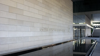
United States Courthouse in Los Angeles
The federal courthouse in Los Angeles, California, Dec. 16, 2025. Madeline Shannon / The Center Square
The proposition, which created the congressional redistricting, passed in the Nov. 4 special election with nearly 65% of the vote. The lawsuit targets the proposition's newly drawn districts that are designed to allow Democrats to pick up five more seats in the U.S. House during the 2026 midterm election.
In previous reporting by The Center Square, Tangipa said the Voting Rights Act mandates that certain standards be met when redrawing districts. He said those standards were not met.
Officials in Gov. Gavin Newsom’s office have said that Mitchell can’t be compelled to testify.
“We’re going to win on the merits,” Newsom said during a virtual press conference on Monday. “We’re very confident we will be successful.”
The Prop. 50 special election in California was in response to the five U.S. House seats Republicans may pick up in the 2026 midterm election because of mid-decade redistricting in Texas.
In November, a federal court blocked the redistricting campaign’s new maps from taking effect in Texas, stating that the Republican majority there ran afoul of voting rights laws by re-drawing districts that discriminated against voters of color, according to The Center Square’s previous reporting.
However, the U.S. Supreme Court upheld the new district maps in Texas, writing in a 6-3 decision that the Lone Star State was likely to win on the case’s merits.
Under Prop. 50, five California Republicans in the House - Kevin Kiley of Rocklin, Doug LaMalfa of Yuba City, Darrell Issa of San Diego County, Ken Calvert of Riverside County, and David Valadao of Bakersfield - all stand to lose their seats in the 2026 midterm elections next year.
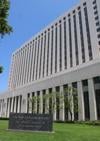
Federal and county courthouse in Los Angeles
The U.S. District Court for the District of Central California is based in the same courthouse as the Los Angeles County Superior Court in downtown Los Angeles, as seen in June 2025. Photo: Dave Mason / The Center Square
Plaintiffs suing to stop the new congressional districts say the Prop. 50 maps were drawn to racially gerrymander the state. At the heart of that argument is a report on California’s districts written by researcher Sean Trende. The report, which was described in court testimony on Tuesday, contained various examples of how congressional districts could be drawn to prevent a racial gerrymander.
“Reviewing his report, he focused on only race and partisanship,” Anthony Fairfax, a demographic and mapping consultant, testified. “He didn’t consider the other factors that could cause district configuration, specifically, traditional redistricting criteria. Minimizing political subdivisions, in my opinion, wasn’t considered, as well.”
Trende also didn’t examine districts as a whole by examining population statistics for particular areas, among other considerations often used in drawing voting districts, Fairfax testified. Those district plans, Fairfax said, were all worse off than the 2025 plan in regards to three traditional redistricting criteria: equal population, contiguity and minimizing political subdivision splits. He also compared the 2021 maps, drawn by the California Citizens Redistricting Commission, and the 2025 maps using the three criteria.
“The takeaway is that both the 2021 and 2025 plans are very similar when it comes to traditional redistricting criteria,” Fairfax testified. “Race did not predominate in the creation of CD 13.”
A Stockton-area resident testified Tuesday that she voted in favor of the newly-redrawn district map that includes her community, which is now part of the 9th Congressional District. When asked in court if she favored electing more Democrats to assist low-income families, she answered yes.
“I think it’s very important to have representation in our community,” said Ines Ruiz-Huston, vice president of special programs and operations at El Concilio, a Stockton nonprofit that helps low-income families.
“We have a lot of families that really need support and help," Ruiz-Huston testified. "I believe that what happens locally affects us nationally, and we need to have representation that will fend for us at a national level.”
Prop. 50, which gave California voters the chance to vote on newly-drawn Congressional district maps, took the responsibility of drawing district lines away from the California Citizens Redistricting Commission, which California voters approved the creation of in 2008. Voters gave the commission, which consists of Republicans, Democrats and independents, the task of drawing state legislative district lines in that 2008 vote. In 2010, voters chose to extend the commission's duties to include congressional district lines, as reported previously by The Center Square.
The Citizens Redistricting Commission was not involved in the drawing of congressional district lines up for approval in the Prop. 50 special election. State officials, including Newsom, have said the new districts would be in effect for the 2026, 2028 and 2030 elections, but noted the independent redistricting commission would draw districts based on the 2030 census.